






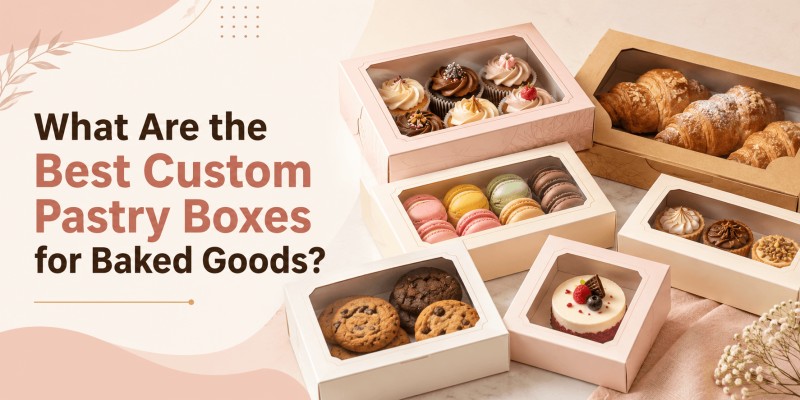
Fresh pastries can quickly lose their appeal when they are placed in weak, oversized, or poorly designed packaging. A beautifully decorated cupcake may arrive with crushed frosting, macarons can slide into one another, cookies may break, and croissants can lose their crisp presentation.
For a bakery, café, restaurant, home-based baking business, or dessert brand, the right pastry box is much more than a container. It protects the product, improves presentation, communicates quality, and helps customers remember your business.
The best custom pastry boxes for baked goods are designed according to the size, weight, shape, freshness requirements, and selling environment of the product. In most cases, sturdy cardboard or Kraft pastry boxes with secure closures, food-safe materials, suitable dimensions, and optional windows provide the best combination of protection, appearance, affordability, and sustainability.
However, the ideal packaging can vary depending on whether you sell:
-
Cupcakes
-
Cookies
-
Macarons
-
Croissants
-
Donuts
-
Brownies
-
Pies
-
Tarts
-
Cakes
-
Mixed pastry assortments
This guide explains how to choose custom pastry packaging that keeps baked goods secure while improving the customer experience and strengthening your bakery brand.
Why Does Good Pastry Packaging Matter?
Customers often see the packaging before they see the baked goods inside. A clean and professionally designed pastry box creates an immediate impression of freshness, care, and quality.
Poorly fitted or damaged packaging can create the opposite impression, even when the product itself tastes excellent.
Good pastry packaging performs several important functions.
It Protects Delicate Baked Goods
Pastries can easily be damaged by pressure, movement, moisture, dust, and handling. A strong pastry box protects frosting, decorations, flaky layers, fillings, and toppings during storage and transportation.
It Improves Product Presentation
An attractive box makes baked goods look more valuable and gift-worthy. Window boxes, custom printing, branded colors, and inserts can turn an ordinary order into a premium presentation.
It Makes Transportation Easier
Properly designed pastry boxes are easier to carry, stack, store, and deliver. Secure closures and stable bases reduce the risk of products tipping or sliding inside the box.
It Promotes Your Bakery
Custom printed pastry boxes can display your:
-
Bakery logo
-
Brand colors
-
Website
-
Phone number
-
Social media details
-
Product information
-
Care instructions
-
Promotional messages
Every time a customer carries your branded box into an office, party, school, or family gathering, your packaging introduces your business to potential buyers.
It Improves the Customer Experience
A beautiful and convenient unboxing experience can encourage customers to take photos, share your products online, recommend your bakery, and place repeat orders.
What Makes a Pastry Box the Best Choice?
There is no single pastry box that works perfectly for every baked product. The best box is one that matches the specific product and the way it will be sold, displayed, stored, or delivered.
Consider the following factors before choosing your packaging.
Choose the Correct Size and Height
A pastry box should hold baked goods securely without squeezing them.
A box that is too large allows products to slide, collide, or tip over. A box that is too small may crush frosting, bend decorations, or make the lid difficult to close.
Height is particularly important for:
-
Frosted cupcakes
-
Cream-topped desserts
-
Mini cakes
-
Fruit pastries
-
Decorative cookies
-
Chocolate-topped treats
-
Tall bakery items
Measure the tallest point of the finished product rather than measuring only its base. Leave enough space between the top of the pastry and the box lid.
For mixed pastry assortments, use inserts or dividers to create separate sections. This prevents brownies, cookies, tarts, and other items from rubbing against each other.
Select Strong and Durable Construction
Thin or low-quality boxes may bend when they contain heavy pastries, several cupcakes, pies, or dense desserts.
The packaging material should support the total weight of the order rather than the weight of only one item.
A sturdy base is especially important for:
-
Cakes
-
Pies
-
Cheesecakes
-
Large donut orders
-
Catering boxes
-
Mixed pastry collections
Corrugated cardboard can be used for heavier items or longer deliveries, while standard folding cardboard works well for many lightweight bakery products.
Reinforced corners, secure tuck closures, locking tabs, and supportive inserts can provide additional protection.
Use Food-Safe Packaging Materials
Pastry packaging should be manufactured from materials suitable for food products.
Greasy, buttery, moist, or cream-filled pastries may require:
-
Grease-resistant liners
-
Food-safe coatings
-
Protective trays
-
Wax paper
-
Parchment sheets
-
Interior barriers
These features help prevent oil stains, moisture damage, and weakening of the box.
Tell your packaging supplier what product will be placed inside the box. You should also explain whether the food will be:
-
Warm
-
Cold
-
Frozen
-
Oily
-
Moist
-
Individually wrapped
-
In direct contact with the packaging
This information helps the supplier recommend an appropriate material and structure.
Look for Easy Assembly and Handling
A beautiful box is not practical if bakery staff need several minutes to assemble it during busy hours.
Custom pastry boxes should:
-
Fold quickly
-
Close securely
-
Open easily
-
Hold their shape
-
Be simple to store
-
Be convenient to carry
Built-in handles may be useful for some products, while flat-top boxes are better when packaging needs to be stacked.
The closure should remain secure during pickup and delivery without requiring excessive amounts of tape.
Consider Product Presentation
Your pastry box should match your bakery’s visual identity.
A handmade or organic bakery may prefer natural Kraft packaging. A luxury dessert brand may choose white cardboard, foil details, embossed logos, rigid boxes, or premium finishes.
A clear window can display colorful pastries while leaving enough space for branding and product information.
What Are the Best Materials for Custom Pastry Boxes?
The packaging material affects the strength, appearance, printing quality, price, sustainability, and performance of the box.
The following materials are commonly used for pastry packaging.
Cardboard Pastry Boxes
Cardboard is one of the most popular materials for custom pastry boxes.
It is suitable for:
-
Cupcakes
-
Cookies
-
Donuts
-
Macarons
-
Brownies
-
Croissants
-
Small cakes
-
General bakery products
Cardboard is lightweight, foldable, printable, and available in different thicknesses.
White cardboard creates a clean surface for vibrant printing, while natural-colored cardboard offers a more traditional appearance.
Cardboard pastry boxes can include:
-
Clear windows
-
Carrying handles
-
Custom inserts
-
Locking tabs
-
Dividers
-
Custom dimensions
-
Printed logos
-
Product information
They are usually an excellent choice for bakeries that want attractive and affordable packaging.
The box thickness should be selected according to the weight of the product.
Kraft Pastry Boxes
Kraft pastry boxes provide a natural, rustic, and eco-conscious appearance.
They are popular among:
-
Artisan bakeries
-
Organic food brands
-
Home-based bakers
-
Handmade dessert businesses
-
Environmentally conscious companies
Kraft boxes work well with minimalist branding, black printing, stickers, ribbons, twine, and seasonal labels.
They can be used for:
-
Cookies
-
Croissants
-
Donuts
-
Brownies
-
Pies
-
Tarts
-
Pastry assortments
Businesses should confirm the food-contact suitability, composition, coating, and recyclability of the specific Kraft material they order.
A natural brown appearance does not automatically mean that every Kraft box is biodegradable, compostable, or free from coatings.
Corrugated Pastry Boxes
Corrugated packaging is stronger and thicker than standard folding cardboard.
It can be suitable for:
-
Large bakery orders
-
Heavy cakes
-
Catering deliveries
-
Long-distance transportation
-
Wholesale pastry orders
-
Products requiring extra cushioning
Corrugated pastry boxes provide additional support and help reduce damage during shipping and delivery.
However, they may take up more storage space and cost more than lightweight folding cartons. They should be used when the extra strength provides a practical benefit.
Rigid Pastry Gift Boxes
Rigid boxes are designed for premium and luxury presentations.
They work well for:
-
Luxury chocolates
-
Gourmet macarons
-
Corporate dessert gifts
-
Wedding favors
-
Holiday pastry collections
-
Premium bakery assortments
Rigid pastry boxes may include:
-
Magnetic closures
-
Ribbons
-
Custom inserts
-
Textured paper
-
Foil stamping
-
Embossed logos
-
Decorative sleeves
These boxes usually cost more than standard cardboard packaging. They are therefore best suited to high-value products, gift collections, and special occasions.
What Are the Best Boxes for Different Baked Goods?
Matching the box style to the baked product improves both protection and presentation.
Best Boxes for Cupcakes
Cupcakes require enough height to protect frosting and decorative toppings.
The best cupcake boxes usually include inserts with individual openings. These inserts hold each cupcake securely by its base and prevent it from tipping or sliding.
Without an insert, cupcakes may:
-
Fall over
-
Touch one another
-
Smudge their frosting
-
Damage decorations
-
Move during delivery
Window cupcake boxes allow customers to see the designs without opening the packaging.
The insert openings should match the cupcake size. Openings that are too large may not provide enough support.
Best Boxes for Macarons
Macarons are delicate and can crack, slide, or lose their shape during transportation.
Long rectangular boxes with fitted trays, cavities, or dividers are often the best choice.
The packaging should keep each macaron upright or securely positioned without placing excessive pressure on the shells.
A clear window can display the colors, while a sleeve or strong folding carton adds protection.
For gift sets, rigid macaron boxes with custom inserts can create a premium presentation.
Best Boxes for Cookies and Brownies
Cookies and brownies can be packaged in:
-
Folding cartons
-
Window boxes
-
Tuck-top boxes
-
Trays with sleeves
-
Gift boxes
-
Kraft bakery boxes
The ideal box depends on whether the products are individually wrapped, stacked, or arranged as a collection.
Dividers help prevent decorated cookies from rubbing against one another. Grease-resistant liners may also be useful for buttery cookies and brownies.
For holiday cookie collections, shallow window boxes provide a wide presentation area and allow customers to see the assortment.
Best Boxes for Croissants and Pastries
Croissants, Danish pastries, turnovers, and similar products need enough room to prevent their flaky surfaces from being crushed.
A shallow or medium-height bakery box with a wide base is usually suitable.
Avoid tightly wrapping delicate pastries when appearance matters. A correctly sized box allows them to maintain their structure while reducing direct contact.
Ventilation may also be useful when slightly warm pastries are packed, although the exact design should depend on the product and required storage time.
Best Boxes for Donuts
Donut boxes should have a wide, stable base and enough height to protect icing, glaze, sprinkles, and toppings.
Window donut boxes are popular because they display the assortment without requiring customers to open the lid.
For large orders, choose a material that will not bend under the combined weight of the donuts.
A grease-resistant liner can help keep the box clean, especially when the products contain oily fillings or sticky glazes.
Best Boxes for Cakes, Tarts, and Pies
Cakes require strong bases and enough height to protect decorations.
Tall cakes may need specialized cake boxes instead of standard pastry cartons.
Tarts and pies benefit from shallow, stable boxes that prevent the product from sliding.
Useful packaging accessories include:
-
Cake boards
-
Food trays
-
Supportive inserts
-
Custom-fit bases
-
Locking corners
Built-in handles should only be used when the box is designed to safely carry the full weight of the product.
Are Window Pastry Boxes a Good Choice?
Window pastry boxes are an excellent option when visual presentation influences the buying decision.
They allow customers to see:
-
Product colors
-
Frosting
-
Decorative toppings
-
Shapes
-
Arrangements
-
Product freshness
Window boxes are particularly effective for:
-
Cupcakes
-
Cookies
-
Macarons
-
Donuts
-
Dessert assortments
-
Retail bakery displays
-
Gift packaging
Windows also make order checking easier. Bakery staff and customers can confirm the contents without repeatedly opening the box.
However, a window box may not be suitable for every product.
A large window can reduce the available printing area and may affect recyclability, depending on the material used and local recycling systems.
The window should be securely attached, food appropriate, and positioned to highlight the product without weakening the box.
How Do Inserts and Dividers Protect Pastries?
Many pastry packaging problems are caused by movement inside the box rather than weakness in the outer packaging.
Custom inserts, dividers, trays, and holders keep baked goods in fixed positions.
Examples include:
-
Cupcake inserts that prevent tipping
-
Macaron trays that reduce cracking
-
Dividers that separate cookies and brownies
-
Cake boards that create a stable base
-
Custom cavities that hold chocolates or mini desserts
An insert should fit both the product and the outer box.
It should be easy for bakery staff to load and simple for customers to remove. Excessive pressure can damage delicate items, while a loose insert provides little protection.
Before ordering a large quantity, test a sample box using the actual finished product.
Carry it, tilt it slightly, place it in a delivery bag, and open it after a realistic journey. This test can reveal:
-
Product movement
-
Weak corners
-
Incorrect measurements
-
Difficult closures
-
Unstable inserts
-
Insufficient height
What Are the Best Eco-Friendly Pastry Packaging Options?
Many customers prefer packaging that uses less unnecessary plastic and can be recycled or reused.
Bakeries can improve packaging sustainability by:
-
Choosing right-sized boxes
-
Reducing unnecessary components
-
Avoiding oversized packaging
-
Selecting responsibly sourced paper
-
Using recyclable cardboard where appropriate
-
Printing disposal instructions
-
Reducing excessive plastic
-
Choosing reusable gift boxes
Kraft and cardboard boxes may be recyclable when they are clean and when food residue, coatings, windows, or adhesives do not interfere with local recycling systems.
Businesses should avoid making unsupported environmental claims. Recycling and composting requirements can differ depending on the material and location.
Sustainability should also be balanced with product protection. Weak packaging that causes food to become damaged or discarded can create more waste.
The best eco-friendly packaging uses the minimum amount of material needed to protect the product effectively.
How Does Custom Printing Support Bakery Branding?
Custom printed pastry boxes turn ordinary packaging into a powerful marketing tool.
You can print:
-
Your bakery logo
-
Brand colors
-
Website address
-
Contact information
-
Social media handle
-
Product details
-
Allergen reminders
-
Storage instructions
-
Reheating guidance
-
Promotional messages
-
Seasonal artwork
The design should remain clean and easy to read. Too much text can make the packaging look crowded.
Focus on essential information and use strong contrast between the background and printed elements.
Popular finishing options include:
-
Matte lamination
-
Gloss lamination
-
Spot UV coating
-
Foil stamping
-
Holographic foiling
-
Embossing
-
Debossing
These finishes can create a premium appearance, but they may increase the packaging cost.
For small bakeries, simple one-color printing on white or Kraft cardboard can look professional without requiring a complicated design.
Branded stickers, labels, and sleeves can also provide flexibility when the same box is used for different products.
How Do You Choose the Right Pastry Box Size?
Start by measuring the finished baked product at its:
-
Widest point
-
Longest point
-
Tallest point
Include decorations, liners, boards, and inserts in the measurements.
For multiple products, arrange them exactly as they will appear inside the box and measure the complete layout.
Add only enough clearance for safe loading and removal. Excess space should be controlled with dividers or inserts rather than left completely empty.
You should also consider whether the box will fit inside:
-
A delivery bag
-
A refrigerator
-
A display case
-
A shipping carton
-
A storage shelf
-
A customer’s vehicle
Check whether empty boxes can be stored efficiently and whether filled boxes can be stacked without damaging the products.
Ordering samples in two or three sizes is often more reliable than depending on measurements alone.
Common Pastry Packaging Mistakes to Avoid
Choosing an Oversized Box
Too much empty space allows pastries to move and collide.
Choosing a Box That Is Too Short
A low lid may touch frosting, cream, fruit, or decorative toppings.
Ignoring Product Weight
A lightweight box may bend when used for dense desserts or large assortments.
Using Packaging Without Inserts
Cupcakes, macarons, chocolates, and decorated cookies may require inserts to remain stable.
Ordering in Bulk Without Testing
Always test a sample with the real product before placing a large order.
Using Too Much Packaging
Unnecessary wrapping, fillers, and oversized boxes increase costs and waste.
Overloading the Design
Too many colors, messages, or decorative elements can make the packaging appear confusing and unprofessional.
Final Thoughts
The best custom pastry boxes for baked goods combine proper sizing, reliable construction, food-suitable materials, attractive presentation, and convenient handling.
For most bakeries, a correctly sized cardboard or Kraft pastry box with a secure base and sufficient height provides an effective packaging solution. Inserts should be used for delicate items, while clear windows can improve presentation and retail appeal.
Corrugated boxes are useful when extra strength is needed, and rigid boxes are suitable for luxury gifts and premium pastry collections.
Before placing a bulk order, test the box with your actual products. Carry it, stack it, transport it, and inspect the baked goods afterward.
Effective pastry packaging should protect freshness and decoration, reduce unnecessary waste, simplify handling, and present your bakery as professional, reliable, and memorable.