






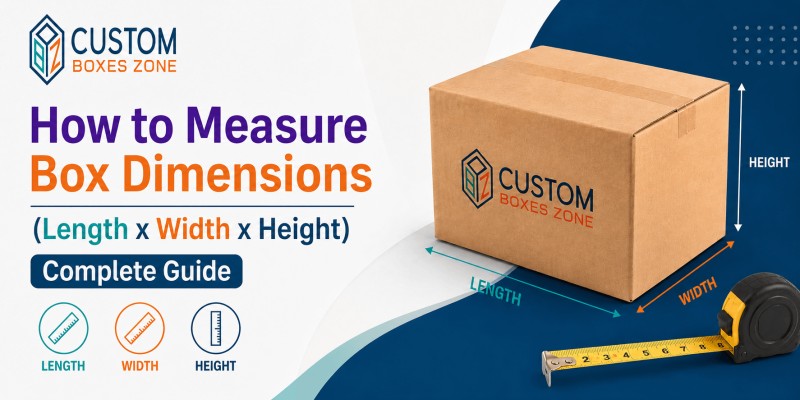
Before you place your next packaging order, it pays to understand exactly how length, width, and height are measured and why the order you write them in actually matters.
This guide breaks down everything you need to know bout box dimensions, a complete guide, from the basic formula to the small mistakes that quietly inflate shipping bills.
What Do Length, Width, and Height Actually Mean?
Every rectangular box has three measurements that define its size:
- Length: the longest edge of the box, measured along the base.
- Width: the shorter edge of the base, running perpendicular to the length.
- Height: the vertical distance from the base of the box to the top.
Together, these three numbers are always written in the same sequence: Length x Width x Height (L x W x H). This is the industry-standard order used by shipping carriers, manufacturers, and packaging suppliers worldwide, so sticking to it avoids confusion when you're requesting quotes or comparing box sizes.
Why Getting Dimensions Right Matters So Much
1. It protects your product. A snug-fitting box keeps items from sliding, bouncing, or colliding with the box walls during handling. Loose space inside a box is the number one cause of shipping damage.
2. It controls your shipping costs. Most major carriers now charge based on dimensional weight (DIM weight) rather than actual weight alone. DIM weight is calculated by multiplying length x width x height and dividing by a carrier-specific divisor (commonly 139 for inches or 5000 for centimeters). If your box is larger than it needs to be, you could be charged for air you're shipping, not your actual product.
3. It maximizes storage and pallet space. Accurate dimensions let you calculate exactly how many boxes fit on a pallet, shelf, or truck, which directly affects warehousing and freight costs.
4. It keeps your branding consistent. Custom boxes that are proportioned correctly to your product look more professional on unboxing videos and retail shelves than oversized, half-empty packaging.
Step-by-Step: How to Measure a Box Correctly
- Lay the box flat with all flaps closed.
- Measure the longest side of the base; this is your length.
- Measure the shorter side of the base at a right angle to the length; this is your width.
- Measure straight up from the base to the top of the box; this is your height.
- Record all three numbers using the same unit (inches or centimeters; never mix them).
- Repeat the process for internal dimensions if you need to know the usable space inside.
A flexible measuring tape works for most boxes; for very small packaging like jewelry or cosmetic boxes, a small ruler or caliper gives more precise results.
How to Calculate the Volume of a Box
Once you have all three measurements, volume is simple:
Volume = Length x Width x Height
For example, a box measuring 14" x 10" x 8" has a volume of 1,120 cubic inches. Carriers use this figure to work out dimensional weight, which is then compared against the box's actual weight. Whichever number is higher is usually what you get billed for.
Quick DIM weight example:
Box size: 14 x 10 x 8 inches → Volume = 1,120 cubic inches DIM weight = 1,120 ÷ 139 = 8.06 lbs
If your actual product only weighs 4 lbs, you'd still be charged based on the higher dimensional weight, which is exactly why right-sized packaging saves money.
Internal vs External Dimensions Know the Difference
This is where a lot of first-time packaging buyers get tripped up.
- Internal dimensions describe the usable space inside the box; this is what determines whether your product fits properly.
- External dimensions describe the total outer size of the box, including the thickness of the material. This is what shipping carriers and warehouses use for cost and space calculations.
When requesting a custom box quote, always clarify whether the measurements you're providing are internal or external. Corrugated and rigid boxes can add anywhere from a few millimeters to over an inch in wall thickness, which changes the final external size significantly.
Does the Order of Dimensions Ever Change?
While length x width x height is the standard, you may come across a few variations depending on the box orientation:
- Height x Width x Length: sometimes used for tall, vertical boxes like bottle or tube packaging.
- Height x Length x Width: occasionally used for wide, horizontal packaging.
- Length x Height x Width: used when viewing a box from its side panel.
None of these change the math volume, which comes out the same regardless of order, but the sequence does matter when communicating with suppliers, since a mismatched order can lead to the wrong box being manufactured.
Choosing the Right Dimensions by Box Style
Different packaging styles are measured slightly differently in practice:
- Mailer boxes: measured L x W x H when flat-folded and again when assembled, since the depth changes.
- Bottle and tube boxes: height is usually the dominant dimension and is listed first for clarity.
- Rigid and gift boxes: internal dimensions matter most, since these are almost always built around a specific product.
- Shipping/corrugated boxes: external dimensions matter most since carriers price based on outer volume.
Knowing which style you need helps your packaging supplier recommend the right dimension format before production even starts.
Common Dimension Mistakes That Cost Businesses Money
- Mixing units (inches on one measurement, centimeters on another)
- Providing internal dimensions when the supplier needed external ones, or vice versa
- Rounding measurements instead of using exact numbers
- Forgetting to account for extra void-fill space, which increases the effective DIM weight
- Not re-measuring after a product redesign or packaging material change
Even a half-inch error across all three dimensions can be enough to bump a box into a higher shipping rate bracket.
Tools You'll Need
- A flexible measuring tape for medium-to-large boxes
- A small ruler for compact packaging (jewelry, cosmetics, electronics accessories)
- A caliper for measuring material thickness
- A notepad or spreadsheet to log dimensions consistently across your product line
Final Thoughts
Getting your box dimensions right isn't just a manufacturing detail; it directly affects how safely your product travels, how much you pay in shipping, and how efficiently you use warehouse space. Always measure carefully, keep your units consistent, and know whether you need internal or external sizing before requesting a quote.
If you're ready to order custom packaging built to your exact product dimensions, our team can help you get the sizing right the first time no wasted material, no shipping surprises.