






Packaging is often the first impression your product makes on a customer. Whether it’s a luxury item or a daily-use product, the quality, color, and design of packaging play a crucial role in influencing buying decisions. When it comes to printing, two primary methods dominate the packaging world: Spot colors and CMYK printing.
Choosing the right printing method can make the difference between a package that simply looks good and one that truly reflects your brand. Let’s dive deep into the differences, advantages, and best use cases of Spot vs CMYK for packaging.
Understanding Spot Colors
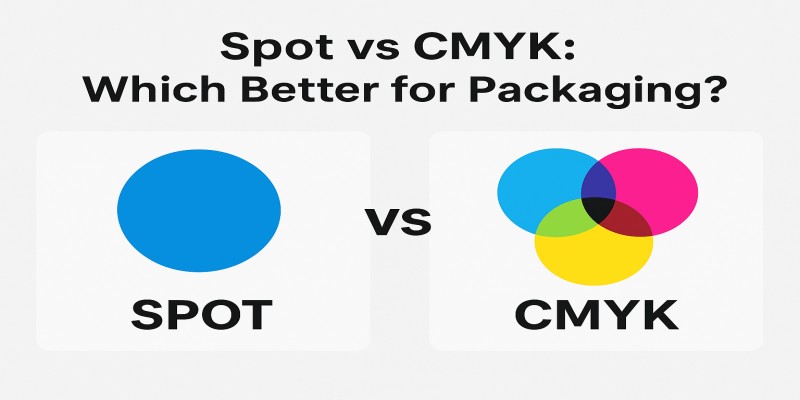
Spot colors are specially pre-mixed inks used to create a precise shade. Each color is applied individually during printing, ensuring uniformity and vibrancy.
Why choose spot colors?
-
Perfect for exact brand colors that must remain consistent across all packaging
-
Ideal for metallic, neon, or pastel shades that CMYK cannot reproduce
-
Essential for logos or design elements where color precision is critical
The biggest strength of spot colors is accuracy. For example, if your brand has a signature red, spot color printing ensures that every package matches that exact shade. This consistency is why high-end brands often rely on spot colors.
Considerations: Spot color printing is usually more expensive, especially if multiple colors are used. It’s also less suited for complex images or gradient designs.
Understanding CMYK Printing
CMYK stands for Cyan, Magenta, Yellow, and Key (Black). Unlike spot colors, CMYK is process-based. By combining these four inks in varying proportions, a wide spectrum of colors can be produced.
CMYK is best suited for:
-
Full-color images, photographs, and gradients
-
Multi-colored designs where cost efficiency matters
-
Flexible printing on various packaging materials
CMYK is highly versatile and generally more cost-effective for designs with multiple colors. However, some shades, like metallics or bright neon colors, cannot be perfectly replicated. Slight variations may also occur between different print runs.
Spot vs CMYK: How to Choose the Right Method
The choice between spot and CMYK depends on your goals, budget, and design:
Spot colors:
Choose when exact brand color matching and consistency are crucial. Ideal for logos and premium packaging.
CMYK:
Choose when you have complex designs, images, or gradients. Perfect for cost-sensitive and large-scale projects.
Hybrid approach:
Many brands combine both methods spot colors for logos and CMYK for background images. This ensures both accuracy and full-color richness.
Cost Comparison
Budget plays a vital role in selecting a printing method.
-
Spot colors: Higher upfront costs due to separate ink setup. Ideal for smaller print runs or luxury packaging.
-
CMYK: More cost-efficient for larger runs or designs with many colors. Uses only four inks regardless of how many colors are in the design.
Balancing cost with design and brand requirements is key. Spot colors may justify the expense for high-end products, while CMYK suits mass-market packaging with colorful, complex designs.
Color Accuracy and Brand Identity
Colors are an essential part of brand identity.
-
Spot colors: Offer unmatched precision and consistency, reinforcing brand recognition.
-
CMYK: Provides vibrant designs but may struggle with exact brand colors like metallics or neons.
For premium branding, spot colors are often essential. For colorful and photographic packaging, CMYK is ideal.
Material Compatibility
The choice of material impacts printing results:
-
Spot colors: Perform exceptionally well on non-porous surfaces like plastics, foils, or coated cardboard. Colors remain vibrant.
-
CMYK: Versatile across multiple materials but may appear less vibrant on matte surfaces compared to glossy finishes.
Choosing the right printing method for your material ensures the intended look and feel of your packaging.
Sustainability Considerations
Sustainability is increasingly important in packaging decisions.
-
CMYK: Produces less waste, as it uses only four inks.
-
Spot colors: May create more waste due to multiple pre-mixed inks for small runs.
Eco-conscious brands can use vegetable-based inks, recyclable materials, or digital printing to reduce environmental impact. Both methods can be adapted for sustainable practices with proper planning.
Future Trends in Packaging Printing
Printing technology continues to evolve:
-
Hybrid presses allow spot colors to be integrated with CMYK in a single print run.
-
Digital printing enables short runs with high-quality results and minimal waste.
-
Eco-friendly inks and sustainable materials make both spot and CMYK printing more environmentally friendly.
Brands can now achieve precise colors, cost efficiency, and sustainability, all in one production process.
Conclusion
There is no single answer to whether Spot or CMYK is better. Your choice depends on: Brand color requirements and consistency, Design complexity and color range, Print volume and budget, Material type and finish, Sustainability goals
Spot colors are unmatched in precision and consistency, making them ideal for premium and high-end branding. CMYK offers versatility, cost efficiency, and flexibility for multi-color designs. Many brands adopt a hybrid approach to leverage the strengths of both.
The right choice ensures your packaging stands out, resonates with customers, and reinforces your brand identity. In packaging, color is not just visual it’s a communication tool that speaks volumes about your brand.