




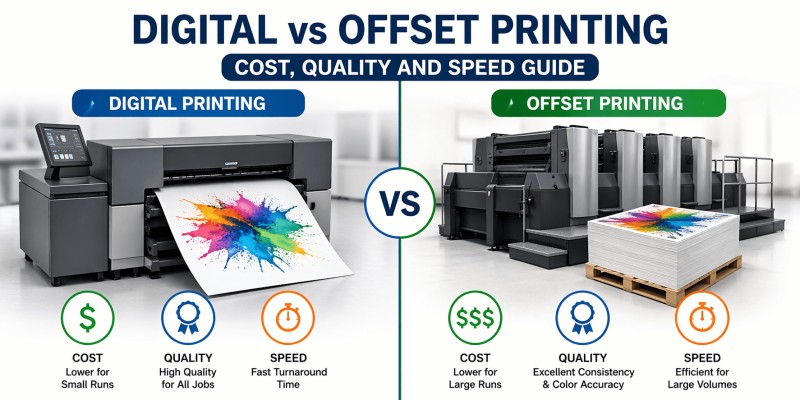
Choosing the right printing method for your custom packaging boxes is one of the most important decisions your business will make. The printing method you choose directly affects your cost, quality, and delivery speed, and making the wrong choice can waste your money or damage your brand image. The two most popular printing methods used in the packaging industry today are digital printing and offset printing. Both produce professional results, but they serve very different needs. Understanding the difference between them is essential before you place your next packaging order. In this complete guide, we break down everything you need to know about digital vs offset printing for packaging, including a full cost comparison, print quality analysis, turnaround time breakdown, and a simple decision guide to help you choose the right method for your specific business needs.
Whether you are a startup ordering your first batch of custom boxes or a large retailer reordering thousands of units, this guide will help you make a smart, informed decision.
What Is Digital Printing for Packaging?
Digital printing is a modern printing method that transfers your design directly from a digital file onto the packaging surface. There are no printing plates required. The design goes straight from your computer file to the printer, much like a high-quality office printer, but at a professional, commercial level.
Digital printing is widely used for short-run packaging orders, prototype boxes, seasonal packaging, and any project where design flexibility and fast delivery are important.
Key Features of Digital Printing:
- No printing plates needed lower setup cost
- Ideal for small orders under 1,000 units
- Fast turnaround, sometimes 2 to 3 business days
- Easy to change designs between print runs at no extra cost
- Supports variable data printing different text or design on each box
- Great for e-commerce mailer boxes and shipping boxes
- Perfect for startups and small businesses testing new products
What Is Offset Printing for Packaging?
Offset printing, also called offset lithography, is a traditional printing method where ink is transferred from a metal plate to a rubber blanket and then onto the packaging material. This process has been the gold standard of commercial printing for decades because of its exceptional color accuracy, sharp image detail, and consistent output across thousands of units.
Offset printing is the preferred choice for high-volume packaging orders where brand color consistency, premium finishes, and superior print quality are critical.
Key Features of Offset Printing:
- Uses metal plates for each color in the design
- Superior image quality with precise color matching
- Most cost-effective for large orders of 1,000 units or more
- Supports Pantone PMS color matching for exact brand colors
- Works with premium finishing foil stamping, embossing, and spot UV
- Best for retail packaging, cosmetic boxes, and luxury packaging
- Consistent quality across thousands of printed units
Digital vs Offset Printing: Cost Comparison
Cost is usually the first factor businesses consider when choosing a printing method. The answer depends heavily on your order quantity.
| Order Quantity | Digital Printing | Offset Printing | Best Choice |
|---|---|---|---|
| 100 – 500 units | Low cost per unit | High setup cost | Digital |
| 500 – 1,000 units | Moderate cost | Break-even point | Digital |
| 1,000 – 5,000 units | Getting expensive | Cost-effective | Offset |
| 5,000+ units | Very expensive | Most economical | Offset |
The break-even point between digital and offset printing is generally around 1,000 to 2,000 units. Below that number, digital printing saves you money because there are no plate setup costs. Above that number, offset printing becomes significantly more cost-effective because the per-unit price drops as your volume increases.
Hidden Costs to Consider:
- Offset printing has a one-time plate creation fee, usually $50 to $150 per color
- Digital printing may cost more per unit, but it has zero setup fees
- For reorders of the same design, offset plates can be reused, saving money long-term
- Rush orders are cheaper and faster with digital printing due to faster setup
Digital vs Offset Printing: Print Quality Compared
Print quality is everything when it comes to custom packaging. Your box is often the first physical touchpoint your customer has with your brand. A poorly printed box signals low quality, even if your product inside is excellent.
Offset Printing Quality:
Offset printing delivers the highest possible print quality for packaging. Because ink is applied directly from a plate, the results are sharper, more vibrant, and more consistent, especially for large solid color areas, fine text, and complex gradients.
- Pantone color matching for exact brand color reproduction
- Richer, deeper ink coverage on packaging surfaces
- Consistent quality across thousands of printed units
- Better performance with premium finishes like foil and embossing
- Preferred for cosmetic packaging, luxury boxes, and retail shelf products
Digital Printing Quality:
Modern digital printing has come a long way. Today's commercial digital printers produce excellent quality for most packaging applications, especially for simpler designs, e-commerce boxes, and short-run projects.
- Good color accuracy using the CMYK color model
- Excellent for photography-heavy or gradient-rich designs
- Consistent from first to last unit in a single print run
- Cannot fully match Pantone colors, only approximates them
- Slight color variation can occur between different print runs
Quality Comparison Table:
| Quality Factor | Digital Printing | Offset Printing |
|---|---|---|
| Color Accuracy | Good (CMYK) | Excellent (Pantone) |
| Image Sharpness | Very Good | Superior |
| Color Consistency | Good per run | Excellent always |
| Gradient Quality | Excellent | Excellent |
| Premium Finishes | Limited | Full range |
| Small Text Detail | Good | Superior |
Digital vs Offset Printing: Turnaround Time and Speed
When you need your custom boxes fast for a product launch, a trade show, or a seasonal campaign, turnaround time matters as much as cost and quality.
Digital Printing Speed:
Digital printing is the clear winner when it comes to speed. Because there are no plates to create and no press calibration required, digital jobs can start immediately after design approval.
- No plate setup printing starts immediately after approval
- Typical turnaround: 2 to 5 business days
- Ideal for urgent orders and last-minute packaging needs
- Design changes can be made up to the last minute at no extra cost
- Perfect for testing new packaging concepts before a full production run
Offset Printing Speed:
Offset printing takes longer to set up because plates must be created and the press must be calibrated before printing begins. However, once the press is running, it produces units very quickly, making it highly efficient for large volume orders.
- Plate creation adds 1 to 3 business days before printing begins
- Typical turnaround: 7 to 10 business days
- Rush production available in 4 to 6 business days
- Best planned for large seasonal or product launch orders
- Extremely fast output once the press is running, ideal for bulk wholesale orders
Which Printing Method Is Best for Your Custom Boxes?
The answer depends on your specific business situation. Here is a simple framework to help you decide:
Choose Digital Printing If:
- You are ordering fewer than 1,000 boxes
- You are a startup or small business testing a new product
- You need your boxes delivered quickly, within 2 to 5 days
- You frequently update your packaging design for new seasons or products
- You are ordering e-commerce mailer boxes or shipping boxes
- Your budget is tight, and you need to avoid upfront setup costs
- You want to order a sample run before committing to a large order
Choose Offset Printing If:
- You are ordering 1,000 or more boxes
- Exact brand color accuracy is critical to your business
- You want premium finishing like foil stamping, embossing, or spot UV
- You sell cosmetics, perfumes, candles, or luxury retail products
- You are reordering the same packaging design repeatedly
- You need consistent quality across thousands of units
- You want the lowest possible cost per box at high volume
Conclusion
Both digital and offset printing have their place in the world of custom packaging. The right choice comes down to three simple factors: your order quantity, your quality requirements, and your timeline. For small businesses and short runs, digital printing offers the best combination of speed, flexibility, and affordability. For large-volume orders where brand color consistency and premium finishes are non-negotiable, offset printing delivers superior results at a lower cost per unit. Understanding these differences before placing your order will save you money, protect your brand image, and ensure your packaging arrives on time every time.
Get Your Free Custom Box Quote Today!